Global Hotspot
The project is located within the Atlantic Forest (Selva Paranaense), which harbors extraordinary species richness and high levels of endemism, while also providing essential functions for climate, water, and soil regulation. However, it is also one of the most threatened ecoregions in South America: it is estimated that only 7.8% of the original forest remains (Holz & Placci, 2003).
This ecoregion is recognized as a highly threatened global biodiversity hotspot (Myers et al., 2000) and as a global conservation priority ecoregion (Global 200) (Olson & Dinerstein, 1998; Olson et al., 2000, 2001).
Aponapó Reserve
Jungle, Refuge and Biological Station
It is a private reserve of the Misiones rainforest, managed by the Huellas para un Futuro Foundation, which serves as a pilot case for the development and certification of biodiversity biocredits, integrating conservation, ecological restoration, and the sustainable use of biodiversity.
The initiative integrates local communities into agroecological production models—such as stevia cultivation, shade-grown yerba mate, and pitanga—through training in good practices and sustainable management, strengthening local capacities. It also promotes environmental education, research and academic partnerships, and fosters local employment in nursery operations, restoration, and monitoring activities.

Landscape-Scale Management Plan

Within just 52 hectares, the Aponapó Reserve concentrates 14 types of land cover and land uses—including mature forest on slopes S/SW and E; gallery forests; spring-protection forests and wetlands; Pinus taeda plantations; wild ecotones; and agroecological production systems of stevia, yerba mate, and pitanga—positioning it as a model case of sustainable territorial design and landscape-scale management.
Seed Trees
In the Reserve, 52 seed trees have been identified, distributed across different environments, functioning as an in situ germplasm bank and constituting a strategic source of seeds for natural regeneration and restoration.


Aponapó Nursery
From the seed trees certified as a germplasm bank, seeds and wild seedlings are collected and then transferred to the Aponapó Nursery.
There, the seedlings are raised in the nursery hardening area until they are properly acclimated, for later use in restoration and enrichment activities.


Forest Enrichment

Enrichment with native species has been implemented in gallery forests and in forests protecting springs and wetlands.
These interventions improve landscape connectivity, facilitate gene flow between populations, promote the establishment of biological corridors, provide habitat for biodiversity, and strengthen ecosystem resilience.

Threatened or endangered species
The Reserve has recorded threatened species of flora and fauna included in the IUCN Red List , which reaffirms its high value for biodiversity conservation.
Among the most important species are:
-
Paraná Pine (Araucaria angustifolia) – Critically Endangered (CR)
-
Guatambú (Balfourodendron riedelianum) and Guabiyú (Myrcianthes pungens) – Endangered (EN)
In addition, the Reserve is home to tree ferns associated with humid forest microhabitats, such as the wild chachi (Alsophila setosa) and the gentle chachi (Dicksonia sellowiana ) , species that have been recognized as vulnerable at the provincial and national levels.
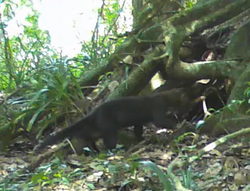
Aponapó also records the presence of native mammals sensitive to fragmentation, such as the margay (Leopardus wiedii) and the black howler monkey (Alouatta caraya) . Their presence is an indicator of ecological integrity, as they require well-preserved forests, connectivity, and available resources over time.
The presence of High Conservation Values is confirmed in the Reserve: HCV 1, due to the occurrence of threatened species; HCV 2, by maintaining a mosaic of interconnected environments at the landscape scale; and HCV 3, through the protection of sensitive and threatened ecosystems and habitats of the Atlantic Forest.